
"Everything is online these days."
You've heard this saying before. Maybe you've said it yourself over a casual chat. It's become one of those things everyone agrees on without really knowing how much digital shapes our daily lives.
Look around, and you'll start to see it. A tabagie now accepts Juice, even though they never had a card machine. Local businesses now have their own websites. A few taps on your phone and dinner will arrive at your door. More business owners are stepping out of their business, travelling, spending time in hotels, enjoying life — because their business can run without their physical presence.
Digitalisation is no longer a “nice to have." It is a necessary part of how businesses thrive. In many larger countries, technology defines business norms, culture, and customer expectations. Mauritius, an island that moves at its own pace, is yet to realise digital’s full potential. Progress has been made, but there is still much that can be done.
What is digitalisation?
Digitalisation is the use of digital technology and data to improve the way your business operates and delivers value to customers. Booking your cinema seat from your phone so you don't arrive to find the film is full. Invoices sent automatically the moment a customer pays online. Meetings that transcribe and summarise themselves so nothing gets lost. Big or small, digitalisation shifts how we think and act towards getting things done. It boosts productivity, allowing people to achieve more with less effort.
In practice, digitalisation leads to four tangible outcomes:
Reduce operational cost & time
Replace manual effort, repetitive tasks, and costly errors.
Increase visibility & sales
Be discovered, gain trust, and be chosen over competitors. Reach new customers with modern campaigns.
Know your business performance
See how your business is doing in seconds — sales, financial growth, inventory, team performance, and more.
Act with confidence
Feel supported with advice that works for your business — with clear benefits, risks, and costs upfront.
By reading this article, you have a unique opportunity to secure a competitive advantage — driving revenue and efficiency gains before you're left reacting when you could have been proactive. This doesn't mean stringing together technology for the sake of being digital. It has to make sense for your business, and simultaneously give your customers a reason to choose you over anyone else.
This article is a starting point. It walks you through what digitalisation actually means for your business, the practical ways to get started, and how to decide your next move.
The current state of digital in Mauritius business
Most businesses in Mauritius have some form of digital presence. At the very least, a Facebook page.
But behind the scenes, orders and payments are tracked in copybooks, WhatsApp messages, and Excel spreadsheets. The cost of manual, time-consuming work adds up fast — compiling performance reports, retrieving customer information, updating records. And that's before accounting for the risk of losing valuable information to a computer crashing or a misplaced piece of paper.
Few businesses are set up with a strong, coherent online presence and the internal systems to organise work efficiently. That gap between online visibility and efficient operations is where much of the opportunity lies.
Most business owners do recognise that digital matters. Where they differ is in where they choose to start, and that usually comes down to their immediate needs. Let’s illustrate this with an example.
Good intentions, unintended consequences
Meet Priya. She runs a boutique in the north of the island, selling locally sourced clothing and accessories. Business is decent, she has a loyal customer base, and her Facebook page gets good engagement when she boosts a post. Most of her day is spent creating content — new posts, new promotions, keeping the page active.

One afternoon, a customer messages her on WhatsApp after seeing a promoted post. They want a dress — the one in the photo. Priya checks the copybook and sees one left in stock. By the time she replies, it had already been sold in-store the day before. Devin, her assistant who manages inventory, was off that day and the copybook hadn't been updated. The customer is disappointed. The sale is lost.
A one-off issue, she tells herself. It won't happen again.

A few months later, enquiries have slowed down. A competitor two streets away has launched an eCommerce website — customers can browse, check stock, and order from home. Some of her regulars have started shopping there instead.
Priya invests in an eCommerce store and sales come in, even outside opening hours. But the original problem is still there. Customers find products online, place orders, and sometimes the item is no longer available in store. The website and the shop are not talking to each other, and Devin is still updating inventory manually in a copybook, but only when he is in.
On Saturday morning, instead of visiting friends and family, Priya opens her laptop and spends the weekend updating her sales Excel file. The numbers confirm it: business is down 20%. There goes her relaxing weekend.
Then comes the call she dreads. A customer wants to cancel a Rs. 30,000 order and get a refund. Priya finds out the customer never received a confirmation email, a payment acknowledgement, or a delivery timeline. Assuming something had gone wrong, they panicked. Priya realises she had received other enquiries about whether orders had gone through, but never thought about automatically keeping customers informed when building her eCommerce store. She had built a shop, not an experience.

Priya has made progress. But every solution has introduced a new problem. A little time spent planning her digital transformation at the start — understanding what her customers would need at every step, and what her business would need to deliver it — could have prevented most of this. Instead, she is reinvesting time and money to fix what could have been built right the first time.
She has solved the symptom, not the problem. And it is costing her more than the original problem ever did.
The 6 pathways to digitalisation
You may recognise parts of Priya's story in your own business. The six areas below are where Mauritian SMEs begin their digital journey, ordered by the way most business owners tend to think about their priorities.
1. Marketing
Definition: Attracting, engaging, and delivering value to the right people at the right time, with the goals of driving visibility, sales, and lasting customer relationships.
Common in Mauritius: The cultural tendency leans promotional for short term results — boosting posts, sharing flyers, posting across platforms to get attention. It's what most businesses see around them, so it's what gets replicated.
Much of what gets posted today is AI-generated. While cheap and efficient, these artworks prevent businesses from standing out meaningfully. Long term vision, customer education, and brand building rarely enter the conversation.
Make it marismart: A marketing approach that blends short-term and long-term focus — helping businesses reach customers who are ready to buy today, while consistently building the familiarity, confidence, and trust that brings in future customers.
2. Integrated Websites
Definition: Designing, hosting, and maintaining a digital business address that represents your brand, drives customers to take action, and connects relevant data across your other tools.
Common in Mauritius: Many businesses feel a Facebook page is enough. And no doubt, Facebook is important in Mauritius. But you do not own it — the rules, the reach, and who sees your content are controlled by the platform, not your business.
More and more businesses are launching websites, which is a positive step. Many of these, however, function as little more than a digital brochure: basic information and a WhatsApp number. Published once, and updated infrequently.
A website should not exist in isolation. When it is connected to your other tools, it can sync product information automatically, answer common questions before they become enquiries, and reduce the time spent on manual follow ups.
Make it marismart: Your website should be built around your business goals and available 24/7 — giving customers an experience comparable to contacting you, beyond your working hours. Keeping your website information updated and your tools connected takes some effort, but the impact builds up significantly over time.
3. Software Implementation
Definition: Choosing and implementing the right software to replace manual effort, organise information, and support your business objectives.
Common in Mauritius: Many businesses still rely on copybooks and Excel to track customer information, inventory, and financial performance. It works up to a point, but it is manual, time-consuming, and heavily reliant on the people maintaining it. When someone is unavailable or leaves, that critical knowledge often leaves with them.
More businesses are adopting software to make work smarter, which is encouraging. But software chosen without a clear understanding of the business can create new problems rather than solving existing ones. A system that does not reflect how the business actually works gets abandoned or underused. Teams are left with a tool they do not fully understand, and the manual habits continue alongside it.
Make it marismart: The right software, chosen for the right reasons and implemented properly, makes your business less reliant on any one person. Customer information, inventory, and performance data are accessible to whoever needs them, processes are consistent, and your team spends less time on the work that supports delivery and more time on the work that actually delivers outcomes.
4. Automation & AI
Definition: Identifying and eliminating repetitive tasks by putting the right tools, processes, and technology in place — so your business does more without needing more people to do it.
Common in Mauritius: Every business has tasks that people handle again and again. Responding to enquiries, copying records from one tool to another, compiling reports that take far longer than they should.
The challenge lies first in recognising the manual work, and then expressing it clearly enough to act on it. Without clear logical steps, how do you choose the right software to implement? How does a new staff member know exactly what they should do, or how their performance is evaluated?
AI is becoming more familiar, but many businesses only hear about the benefits without seeing them applied in practice. That gap between awareness and application leaves a lot of potential to reduce time, costs, and effort still unexplored.
Make it marismart: Start by mapping out the tasks that repeat themselves — the steps that make them work, where information is stored, who makes decisions along the way, and how success is measured. That clarity is what allows you to choose the right tools, onboard new staff confidently, and identify where automation and AI can genuinely add value. The goal is a business that runs effortlessly — less dependent on people, less vulnerable to distractions, and with more time and energy to focus on more important work.
5. Performance Tracking
Definition: Measuring, analysing, and reporting on business activity to give decision-makers a clear and accurate picture of performance.
Common in Mauritius: Financial tracking is recognised as important, and most businesses do some version of it. But what gets tracked is often recorded manually — copybooks, Excel spreadsheets, updated when there is time. The data is surface level. It gives you an overview but not the full picture.
Where enquiries are actually coming from, which products are quietly underperforming, who your most loyal customers are — these questions rarely have a clear answer.
Without reliable data, decisions are made on instinct and memory. That works until it doesn't — an overstock of a slow-moving product, an opportunity missed, or an advertising budget spent in the wrong place.
Make it marismart: Business performance should be visible in seconds, not pieced together over hours. The right tracking setup tells you what is selling, who is buying, where customers are coming from, and how your team is performing — so you can make decisions with confidence.
6. Digital Strategy
Definition: A practical guide to solving your business challenges using digital — built around your goals, your customers, and the realities of operating in Mauritius.
Common in Mauritius: Without a clear strategy, most businesses approach digital reactively. A competitor starts marketing, so they follow. A friend recommends a platform, so they try it. What happens is solutions get applied that are either too simple to make a real difference or too complex for their team to actually use.
What gets lost in the process is the customer. Digitalisation decisions are made from the inside out — focused on what the business wants to implement, rather than how customers will actually experience it.
Make it marismart: Build your digital strategy around your specific goals, the size and nature of your business, and the Mauritian market. One that accounts for what your customers need at every interaction, gives you a clear order of priorities, and makes sure every digital decision moves your business forward rather than adding complexity for the sake of being digital.
Same actions. Different intentions.
Priya's friend Jamila runs a premium hair salon in the central region. Business is fantastic. Her regulars are loyal, her staff are skilled, and referrals keep new customers flowing in. But something has been bothering her.
Weekends and after-work hours are chaos. Every chair is full, customers spend too long waiting in the queue, and her staff are stretched. By contrast, Monday to Thursday mornings are very quiet. Staff are on full-time salaries, and arranging part-time schedules is a headache she doesn't want to bother with.
On top of that, she doesn't have a dedicated receptionist. Appointments come in by phone and WhatsApp, distracting staff and customers in the middle of a procedure. Sometimes messages get mixed, and sometimes customers don't show up.
Jamila is making comfortable money. But she knows the salon could work better. She wants to make her business marismart.
She starts by thinking about what she actually needs, not what other businesses do. She accounts for her challenges, her goals, her team's capacity, and her clients' needs. She comes up with an answer: she needs to shift demand to non-peak hours and have a central place for all bookings.

She hires a developer to build a website with an integrated booking engine. Customers can see availability, choose their stylist, and book at any time of day without calling the salon. To reduce no-shows, she requires payment upfront at the time of booking. A confirmation email goes out immediately to the customer with the appointment details, and an SMS reminder follows the night before.
Then she does something smart. She offers a 10% discount on off-peak slots — Monday to Thursday mornings — but only when booked and paid for online. She prints the promotion on a poster for the salon so her existing customers know about it. She also sets up an away message on WhatsApp directing customers to the booking system and informing them of the same 10% savings offer. Her staff are instructed to do the same — framing it as a practical way for customers to save time and money. Within weeks, regulars who used to queue on Saturdays start shifting their appointments to quieter days.

The booking system also gives her staff predictability. They are informed in advance who’s coming at which time. They can also record their client’s stories and preferences, avoiding the awkwardness of a one-sided memory. This information allows other staff to also cater to the client’s preferences if necessary. No matter which staff member is on, every client is made to feel valued.
Three months later, the plan worked. The new website is bringing in more customers than before. Peak hours are slightly less hectic. Off-peak slots are filling up consistently. Staff feel calm in control, customers feel more relaxed, and Jamila can plan her week with a degree of certainty she never had before. No-shows have dropped significantly. Her phone slowly goes quiet.

Jamila did not wait for a problem to force action. She saw an opportunity, made a plan, and built something that works for her business and her customers at the same time. The difference between Priya and Jamila was not budget, or technical knowledge. It was a plan backed by intention.
The 5 pillars that enable successful digitalisation
Successful digitalisation works when two things align: what your business needs and what your customers want to achieve. These are not always the same thing. Business goals are about profit and growth. User goals are about confidently achieving their tasks.
They meet at the interaction layer: a website visit, a social media enquiry, an online payment, a follow-up message. Each one is a moment where your business either strengthens or weakens relationships. While Jamila strengthened her business relationships, Priya unfortunately weakened hers.
That interaction layer is only as strong as the infrastructure that shapes it. Every digital interaction between businesses and customers is shaped by five underlying pillars. Think of them as the conditions that determine whether a digital interaction works. They are ordered here from the business outward to the customer.
Regulation: What are the rules? Data protection, e-commerce frameworks, digital transactions. Operating within the right boundaries protects both your business and your customers.
Technical: What is your business technically capable of delivering? The tools, systems, and integrations that power your digital presence determine what is possible.
Communication: What is being said, how it is being said, where, and by whom? Communication affects the relationship between customers and businesses.
Trust & Security: Does your customer feel safe? Do they trust that their data, their money, and their information are protected? Trust is built slowly and lost instantly.
Usability: Does it help customers achieve their goals? Can your customer successfully use technology? Is it intuitive, fast, and easy to navigate on different devices?
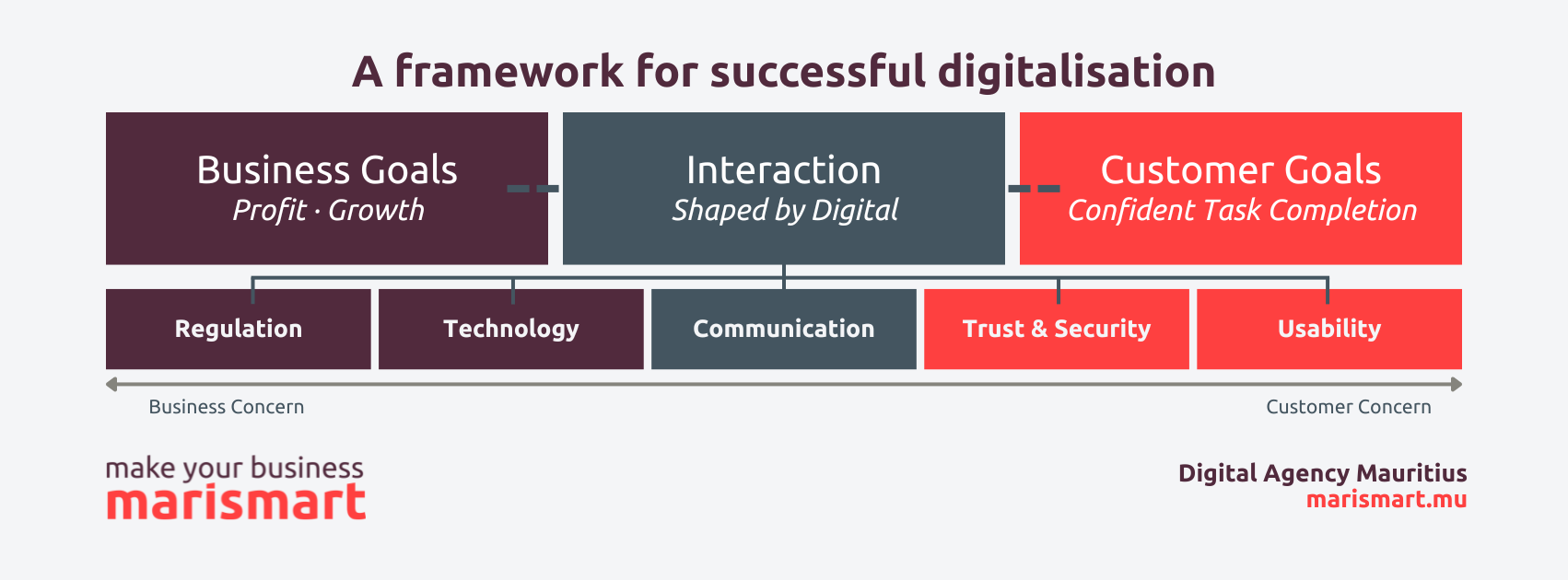
No single pillar is enough on its own. Not all customers care about your compliance framework or technical architecture — but they will immediately feel it in the usability, trust, and communication. All five work together, and a weakness in any one of them shows up exactly where you can least afford it — in the interaction.
Get started with successful digitalisation
Digitalisation is an ongoing process. Every business is at a different stage, with different priorities and capabilities. Your first step is to get clear on what is affecting you most right now, how much it is costing you, and how motivated you are to change it.
You do not need to have all the answers. You need a clear picture of where you are and an honest conversation about where you want to go. This involves knowing what success looks like and how you will measure it.
Common reasons holding businesses back
Already tried it and it didn't work: Most attempts fail not because of the technology, but because of the approach, including wrong timing. Without a clear plan for your specific business, digital tools can solve the wrong problems or create new ones.
My business is too small: There is no minimum size for doing things more efficiently. Even one hour saved per day adds up to over 300 hours a year. Small businesses often see the biggest returns because the gains are immediate and visible, and compound as they grow.
Limited budget: Start with what you can afford. Some of the most impactful improvements cost very little — an updated Google Business profile, a simple booking system, a free invoicing tool. Build from there as results come in.
No time: That is exactly the problem digitalisation solves. The right tools give you time back. Start small, outsource where you can, and let the system do the work.
My team or customers won't understand it: This is a real concern in Mauritius worth taking seriously. Introducing something new takes communication, patience, and training. The goal is not to force a change overnight, but to bring your team and customers along gradually, showing them how it makes their life easier, not harder.
Not technical: You do not need to be. The best digital solutions are built for people who are not technical. If it is too complicated to use, it is the wrong solution. If implementation feels beyond your capacity, hiring or outsourcing the expertise you need is always a valid option.
Don't know where to start? That is exactly what an advisory call is for.
In one hour, we look at your business together — your challenges, your goals, your immediate needs — and walk away with practical next steps that make sense for your business, your team, and your budget. No unnecessary complexity, no pressure.
MUR 2,000 for one hour.
Every business starts somewhere. The question is whether you start with a plan.
Ready to go digital?
Let's talk strategy, plan, results, and implementation