
Most Mauritians are digital. Few Mauritian businesses are digitalised. The difference may be costing them more than they realise.
Digitalisation is a hot topic right now: government speeches, business seminars, and even in conversations over dinner. Everyone is talking about it. But beyond the fancy term, what does digitalisation actually mean for businesses in Mauritius, and what’s the point of it?
Let’s think about it first from the business’ perspective:
How many times do you answer the same enquiry you have answered a hundred times before? How long does it take to send invoices and chase payments, again? How many hours this week went into an Excel sheet just to understand how your business is performing? And if you stopped posting on social media tomorrow, could customers still find you?
You are busy. But is that work productive? Every hour spent on repetitive tasks is an hour taken away from something more productive or enjoyable.
Now think about your customers. Can they reliably find out information about your businesses? How long do they spend researching the options, asking around, enquiring, and hesitating to make a purchase?
Every hesitation a customer experiences carries the risk of lost revenue, for example:
- Time spent making and answering enquiries
- Sales lost to competitors with more information available or who respond faster
- Misunderstandings from unclear or manual communication
- Customers lost through lack of follow-up or inconsistent after-sales communication
These are just some of the costs of not digitalising. Small, quiet actions and mistakes compound over time. Time is money, and by wasting time, we are effectively burning what we worked so hard to earn.
This article is not about technology for the sake of it. It is about understanding what digitalisation genuinely does for a business like yours — and finding the clearest path to making it work.
Is Mauritius ready for digitalisation?
Before diving into what digitalisation can do for your business, it is worth asking a more fundamental question: is it actually worth it? Let’s address Mauritius’ unique cultural economics as well as the opportunities and barriers:
Mauritius’ digital history
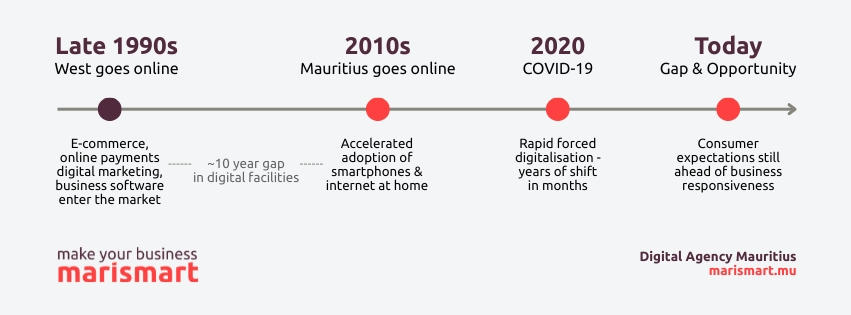
In the West, the internet entered mainstream home use in the late 1990s and early 2000s. Online shopping, digital marketing, and business management software were already reshaping how businesses and consumers interact, while Mauritius was still in the early stages of connectivity. By the time affordable smartphones and accessible data plans brought Mauritians online en masse in the 2010s, the gap in digital familiarity was already a decade wide.
Digital adoption progressed slowly over the years until COVID-19 changed the pace overnight. Strict lockdowns forced businesses and consumers to adapt rapidly — transactions moved online, services went digital, and behaviour that might have taken years to shift changed in months. Consumer expectations have not looked back, but the gap between what is and what could be is still very present.
A connected island
With average internet speeds ranging from 60–100 Mbps and widespread 4G/5G coverage, Mauritius enjoys some of the fastest and most accessible internet in Africa. Over 1 million Mauritians are online, nearly 80% of the population. More than 70% of them are active on social media. Facebook remains the dominant platform since the 2010s, deeply embedded in how businesses and consumers connect daily.
The digital services landscape in Mauritius is also expanding rapidly to serve the growing user base. Banking apps, online payments, e-commerce platforms, and locally built software solutions are more and more making their way into the mainstream.
The digital Mauritian customer
The increase in digital facilities combined with Mauritius' increasing international connectedness produces a new type of customer. Young people who have grown up with technology are joined by a growing community of international students, expats, and diaspora visiting or relocating from markets where digital is simply expected.
When these audiences experience frustration from a lack of information, uncertainty, or slow response times – they might simply move on. They are not being unreasonable. They are simply used to better.
This is the opportunity. The current market sophistication in Mauritius is low enough that small improvements yield massive results.
The talent is here
Mauritius also has a growing community of creatives, software developers, digital marketers, and software implementation specialists. Tech and entrepreneurship communities are active and expanding across the island.
Local tech and software companies are operating, growing, and increasingly building solutions designed specifically for the Mauritian market. The capability to digitalise is present, but we cannot expect platforms that exist abroad to have the same success in Mauritius without adapting for local context and behaviour.
Counterargument: not everyone is ready
Mauritius has an ageing population, and a meaningful segment of customers still values the personal, relationship-driven experience that local businesses have long been built on. A phone call. A familiar face. A handshake repeated across the years. That preference is real and should not be dismissed.
The two can co-exist. The businesses losing ground are not the ones maintaining human relationships, but those that don’t have a way for customers to assess them online before they decide to walk in.

The knowledge & solution gaps
Even for business owners who want to digitalise, knowing where to start is genuinely difficult.
Digital knowledge in Mauritius tends to arrive in fragments: a recommendation from a friend, a tip from a seminar, a Facebook ad, a cousin who works in IT.
Layered on top of this are assumptions that have quietly expired. That posting more frequently leads to more customers. That a website, once built, looks after itself. That running a boosted post is the same as having a marketing strategy. These were never entirely true and the small results they occasionally produce are favoured over the larger results that could come from doing it properly.
Decisions get made on incomplete or outdated information, and the results are mixed at best.
In attempts to digitalise, many are drawn to internationally recognised tools that beautifully serve their respective markets. Unfortunately, many of them can be expensive once currency conversion is factored in, or simply not built for the local market. In many cases, either business owners cannot find suitable local alternatives (if any exist) or prefer to stick to what they are familiar with. And now, AI has entered the conversation. Despite most business owners having heard of it, few can visualise what it actually means for a business like theirs.
Then there is the language problem. Much of the conversation around digitalisation is dominated by technical terms that mean very little to someone who is focused on their profit. Terminology adds to the learning curve, making digitalisation feel like it's too complicated to bother with.
There is rarely a complete, honest picture of what tools exist, what they cost, and what they can realistically do for a business of a given size. So where does a Mauritian business owner go to build modern, relevant, plain-language knowledge and the confidence to act on it?
The fear of mistakes
Beyond knowledge, there is another barrier, more personal and rarely spoken about openly.
Many business owners and employees are simply afraid. Afraid of not understanding the technology well enough to use it properly. Afraid of investing time and money into something that does not work. Afraid of changing processes that, however inefficient, have kept the business running. Manual work feels safe precisely because it is familiar - you know what you are doing, even if it takes longer than it should.
There are also implications for your personal and business reputations. The feeling of wrong decisions and mistakes inviting judgement, ridicule, or losing credibility in front of peers, customers, or competitors is very real. Concerns about online security, especially scams and hacking, and the associated liability, can make the digital world feel more like a risk than an opportunity.
These fears are not irrational. They are human. And in a market where the guidance available is fragmented, terminology-heavy, and often expensive, they are also understandable.
But these are exactly what good guidance is designed to remove.
Regulation around digital
The regulatory environment around digital business in Mauritius is still evolving. Some frameworks exist but are dated. Others are absent entirely. The rules around data protection, e-commerce, and digital transactions are still being written. Frequent changes in regulation bring uncertainty for businesses trying to do things properly.
The government has recognised this. The Digital Transformation Blueprint 2025–2029 sets out a national roadmap with clear intent to modernise the regulatory landscape and position Mauritius as a competitive digital economy. SME grants and financial incentives are available to help businesses make the leap, lowering the financial barrier that stops many from getting started.
A positive change in perspective: businesses that innovatively engage with digitalisation now are not just adapting to the rules. They are in a position to help shape them. Early movers in a regulatory environment that is still forming have influence that latecomers never will.
Closing the gap
The gap in Mauritius is real. It is also understandably a natural consequence of rapid economic growth in a compressed timeline, where markets moved faster than mindsets.
Despite the barriers, the opportunity is largely present. Mauritius has the infrastructure, consumer audience, and capacity to make it happen. But are businesses ready?
The question is no longer whether to digitalise. It is how to successfully navigate the untapped opportunity.
Digitalisation in Mauritius: is it worth it?
| Theme | Verdict | Summary |
|---|---|---|
| Connectivity | Opportunity | Over 1 million Mauritians are online with digital payments and platforms growing rapidly. Internet infrastructure is in place. |
| Attitudes | Opportunity with conditions | Growing awareness and willingness exist, but empowering businesses, employees, and customers to overcome hesitation is essential. |
| Behaviour | Mixed | A blend of optimism and scepticism. Mauritians are increasingly willing to engage online, particularly with brands they already know and trust. |
| Digitalisation Pathways & Market Maturity | Opportunity | Low market maturity creates real space for locally relevant solutions. The communication gap between what is available, technical talk, and what businesses need to achieve their objectives must be closed. |
| Talent | Opportunity | A growing community of developers, creatives, and digital specialists is building capability locally, with solutions increasingly designed for the Mauritian market. |
| Regulation | Optimistic | Frameworks exist but lag behind. Government support and SME incentives signal clear intent. Early movers have the chance to help shape the rules. |
| Competition | Opportunity | The bar is still low enough that smart, intentional digitalisation is a genuine competitive advantage for businesses willing to act now. |
Ready to go digital?
Let's talk strategy, plan, results, and implementation